Feature Article
From Reading the Room to Raising the Room
What it means to listen for what a room is capable of, and what keeps most of us from hearing it.
Read More →
Skip Griffin

Most transformation efforts fail not because the solution was wrong but because the people who need to implement it are the same people who stand to lose from it. Skip Griffin draws on decades of organizational work — and one formative year inside a Boston high school — to explain why elegant design isn’t enough, what the hidden accounting looks like, and how leaders can build something worth saying yes to.
The people who need to cooperate for the solution to work are the same people for whom the solution is a problem. That’s not irrational. That’s human. And until you reckon with it directly, the elegant solution stays on the whiteboard.
There’s a conversation I’ve had more times than I can count, in corporations, in government agencies, and in movement organizations. It goes something like this: everyone in the room agrees that the new design makes sense, the logic is sound, the data supports it, and the leader at the top wants it. And then, over weeks and months, nothing moves.
People call it resistance. They call it inertia. Or they call it culture. What it usually is, if you look honestly at who’s in the room and what they stand to lose, is much more specific: the people who need to cooperate for the solution to work are the same people for whom the solution is a problem.
That’s not irrational. That’s human. And until you reckon with it directly, the elegant solution stays on the whiteboard.
I’ve been coaching a senior leader inside a large international institution for several years now. An organization so large it sits above governments and countries on many of its decisions.
When we started, her unit was a coordination wreck—budget cycles blowing past deadlines, hiring decisions sitting in limbo, departments that technically served the same mission operating like separate countries. The problem wasn’t that people were incompetent. It was that nobody had designed for the whole. Everyone was running their own race inside the same building.
We started building differently. Instead of trying to fix each function in isolation, we worked on how they moved together. We used the metaphor of a Formula One pit crew. The concept was suggested by two members in the extended leadership team and people in the unit embraced it as theirs. They started thinking about sequencing: who does what first, who hands off to whom, what does the car need this lap versus the next one. Budget and HR and IT began to talk to each other not because a policy said they had to, but because they started to see that their work only made sense in relation to the others’.
The results were real and measurable. Budgets that used to finish late started finishing early. That sounds like a small thing until you understand what it unlocks: when the budget is done, people can make hiring decisions. When hiring decisions can be made, positions get filled. When positions get filled on time, country teams can actually function. A budget finishing early is not a finance story. It’s the result of a cascade.
Then came the push to extend the model to a larger institution. Same logic. Better evidence. Clear mandate from leadership. And the resistance that came back wasn’t confusion or skepticism. It was the sound of people doing the accounting.
If this works, we are no longer the center of it. People who have held a particular kind of authority in this system will have to share it, and sharing it means it’s smaller. That’s the math. Nobody says it in those words in a meeting. But it moves through everything: the pace of response, the quality of questions, the things that get agreed to in principle and then never quite get scheduled.
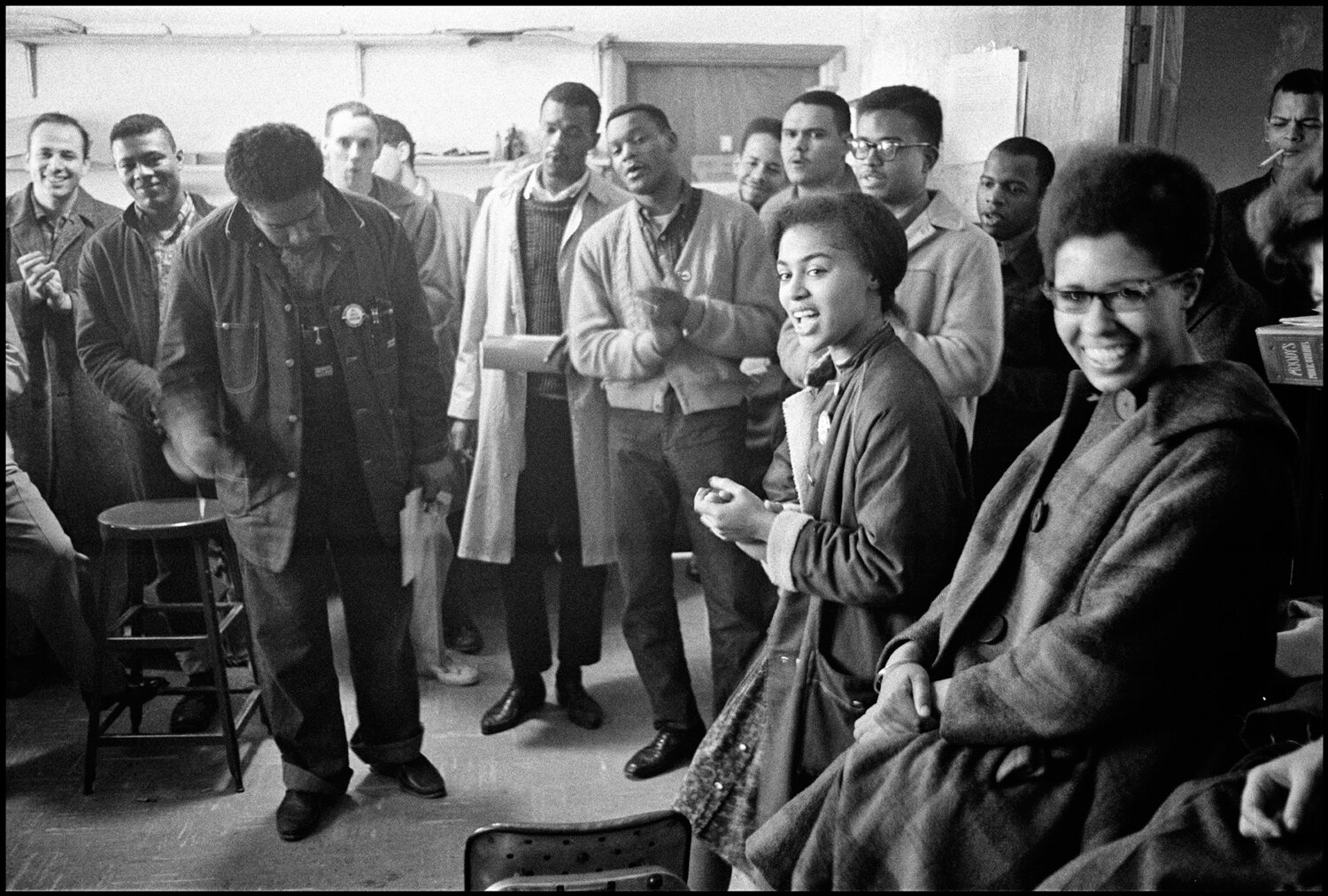
Singing in the office of the SNCC office (founded by Ella Baker) in Atlanta, (from left) Mike Sayer, MacArthur Cotton, Forman, Marion Barry, Lester McKinney, Mike Thelwell, Lawrence Guyot, Judy Richardson, John Lewis, Jean Wheeler, and Julian Bond, 1963, Danny Lyon.
Ella Baker understood this before most of the frameworks we use today existed. Working inside the civil rights movement in the 1950s and ’60s, she developed an approach to organizing that was structurally ahead of its time. Don’t build the movement around one leader, she argued. Go into communities, find the people who already hold trust at the ground level, train them, connect them, build a network of local leaders who can sustain the work whether or not any single person is standing at the front.
The reasoning was sound. If the movement depends on one visible figure, one assassination ends it. A distributed network of strong leaders is harder to kill and harder to stop. Baker didn’t use the language we’d use now—nodes, networks, distributed systems—but that’s exactly what she was building. Her motto was simple: strong people don’t need strong leaders.
She was right about the design. The design did not prevail. Not fully. Not while it mattered most.
Because the men who wanted to lead a mass movement were not enthusiastic about a model in which nobody leads it. You could see the logic, agree with the logic, and still not want to live in a world where your particular kind of leadership was no longer the point. The tension between Baker’s model and the charismatic leadership model was never just strategic. It was a fight about who gets to be in front. And people who want to be in front will find ways to make even correct solutions difficult to implement.
I don’t say that to be cynical about the civil rights movement, which achieved extraordinary things through extraordinary people. I say it because it’s one of the clearest illustrations I know of a pattern that shows up everywhere: shared purpose is real, and shared purpose is not enough. The accounting still happens underneath it.
Most diagnostic work starts in the wrong place. When you go into a system with a problem to solve, you’re almost always starting from the same place: the usual suspects. The leaders who have titles. The data that confirms the hypothesis you walked in with. The people who show up to the meetings you call. That’s the school you think you’re running.
There’s another school. And if you want to understand why things aren’t moving, that’s the one you need to find.
I learned this at 29 years old, during the South Boston busing crisis. A federal judge had placed a receivership team in charge of South Boston High School because he didn’t trust the Boston School Committee to run it. I was one of seven people put in charge. The school had serious student-on-student violence, and because of my background, I was charged along with one other person with building relationships with students and ending the fighting—getting kids to stop being representatives of two communities, the Black community from Roxbury and the mostly Irish Catholic community from South Boston, and start being members of the same school.
Two students, who had taken to calling us Starsky and Hutch after the cop show, pulled us aside one day. They said: you all are talking to the football captains and the student body presidents. You’re working in one school. We go to school in another school.
Then they showed us a building addition that didn’t appear on any of the blueprints. They had found a doorway between the two sections of the building that led up to the roof. When kids needed to disappear after a fight, to avoid getting suspended, that’s where they went. Both communities used it. They didn’t fight up there. It was the one place in that building that wasn’t anybody’s territory.
That’s just one example, they said. We’re showing you to make the point.
We went back to the team and the judge and said: we need to talk to the students about the school they actually attend, not the one we think we’re running. Once we got that permission and started doing it, things started to shift.
Whenever we go into an organization, we do this work through something we call X-ray—the practice of going in with the working assumption that you don’t yet understand the system you’re in, because you’ve only been engaging with a particular set of actors and a particular set of data. You’re looking for confirmation. You need to look for what you’re missing.
That means building relationships with people who don’t show up in the org chart as the decision-makers. It means asking questions that might not confirm what you think is going on. It means staying in the system long enough, and close enough to the ground, to find the room that doesn’t show up in the blueprints.
Part of what X-ray surfaces is the gap between what an organization says it does and what it actually does. There’s a useful distinction here: espoused rules are the official version, the policies, the stated values, the org chart. Rules in use are the behavior you can actually observe. In most systems under pressure, those two things are not the same. People know the gap. They navigate it every day. They just don’t usually tell you about it until you’ve earned enough trust to be shown the roof.
This is what Baker was building toward in her organizing model. Don’t go to the recognized leaders first. Go into the community and find out how things actually move. Who do people actually listen to? What do they actually trust? Where are the real conversations happening?
The elegant solution almost always fails for the same reason the receivership team almost failed at South Boston High: it’s designed for the school on the blueprints, not the school the students actually go to. Until you know the difference, you’re solving the wrong problem.
There’s another piece of this history that gets smoothed over in the popular narrative. When desegregation came, it was not an unmixed victory for everyone on the same side of the moral argument. Black business owners who had built restaurants and hotels serving a segregated market had done something real. They had found a way to build economic power inside a brutal system. Their establishments were often elegant, sometimes the finest available to Black travelers anywhere in the country. And they had, in effect, a monopoly on that market.
Integration changed that. The Sheratons and the Hyatts came in. The monopoly ended. Some of those business owners thrived by competing in the broader market. Others didn’t. The irony was profound: they had made their money under a system that prevented them from spending it freely, and now the freedom they had wanted was going to cost them the market they had built.
I’m not suggesting they were wrong to want desegregation. I’m saying the accounting was real. And the people who had to do that accounting—who had to look at what freedom would cost them specifically, not in the abstract—experienced something that the movement’s narrative had no good language for.
This comes up in organizations all the time, and we pretend it doesn’t. We talk about change management and stakeholder alignment and organizational culture, and all of that language has a way of floating above the specific question: if we do this thing that makes the whole system better, who ends up with less than they had before? Until you answer that question honestly, and design for it, the people who are doing that math in their heads will find ways to slow things down. They won’t say that’s what they’re doing. They may not even fully know that’s what they’re doing. But that’s what’s happening.
The question is never whether the accounting is happening. It’s whether you’re willing to look at it directly.
There’s only one thing I’ve found that consistently shifts the accounting, and it’s not a better argument. It’s a bigger game.
When people can see that the new arrangement puts them in play for something larger than what they stood to protect, the math changes. Sometimes dramatically. The person who was guarding their position in a system serving two hundred people can become genuinely energized when they see they could be building something that serves two thousand. The power they were protecting turns out to be a fraction of what’s available on the other side.
This requires leaders who understand the difference between a vision and an incentive structure, and who are willing to do the harder work of figuring out what each person in the system actually stands to gain, not just what the organization stands to gain. Those are not always the same thing, and pretending they are is one of the most reliable ways to get a transformation effort that looks good in the presentation and goes nowhere in practice.
In the institution I described earlier, the unit that built the pit crew model started to see results that surprised even them. Budget finished early. That was the visible win. The less visible win was that people in the unit started to feel differently about their work. They stopped thinking of themselves as the budget department or the HR department or the IT department. They started thinking of themselves as the people who make the whole thing run. That’s a different identity. It carries different pride. And pride, it turns out, is a stronger motivator than efficiency arguments.
When the proposal went to the larger institution, the people resisting it weren’t being offered that identity. They were being offered a smaller version of the one they already had. Of course they hesitated.
The belief that good design will prevail on its own merits is one of the most persistent mistakes in organizational work. I’ve made it myself. You put something together that is genuinely well-reasoned, that addresses the real problem, that the data supports, and some part of you expects that the rightness of it will carry the day.
It doesn’t work that way. It has never worked that way. The history of movements, of institutions, of every organization I’ve worked inside is littered with solutions that were correct and didn’t get implemented, because someone’s interest in the old arrangement was stronger than their interest in the new one.
What I’ve learned—slowly, and sometimes the hard way—is that you have to start the work earlier and go deeper than the design. You have to understand what each person in the system holds, what they’ve built, what losing the current arrangement would actually mean to them. The goal isn’t to manipulate that understanding. It’s to design around it honestly. To find the version of the solution that makes the whole better and makes it possible for people to come with you.
Sometimes that’s not possible. Sometimes the person guarding the position really can’t be brought along, and the work is about finding the leaders who can build around that. That’s a harder conversation, and it requires its own kind of clarity.
But most of the time, the people on the other side of a stalled transformation are not bad actors. They’re people who can see what the new arrangement costs them and can’t yet see what it opens up. They’re waiting for a bigger game. The question is whether you’re willing to build one big enough to bring them in.
When you get that right—when the vision is large enough that people can see their way into it, when the design accounts for what people actually stand to lose and creates a credible path to something better—things move fast. Decisions that were stuck start to travel. Energy that was locked in protection starts to flow toward building. The system that looked frozen turns out to have been waiting.
That’s the work. Not the elegant solution, but the accounting that makes the elegant solution survivable.
What it means to listen for what a room is capable of, and what keeps most of us from hearing it.
Read More →
Mark Carney’s invocation of Václav Havel at Davos struck a chord because it was a clear example of true character in expression. We can admire from afar, or we can follow that example. In a time of fracture and drift, living within the truth is not an occasional thing. It is a daily act of leadership.
Read More →

We all operate inside a living system of thought, emotion, and relationship—a shared code that shapes how we sense and act together. Drawing from decades of fieldwork, Bill Isaacs and Skip Griffin show how attention moves through four layers—Reaction, Nous, Field, and Identity—and how learning to work with these layers allows transformation to unfold as a natural process rather than an engineered event.
Read More →

You don’t need perfect clarity to start to get unstuck—just the willingness to listen, and the courage to engage.