What it means to listen for what a room is capable of, and what keeps most of us from hearing it.
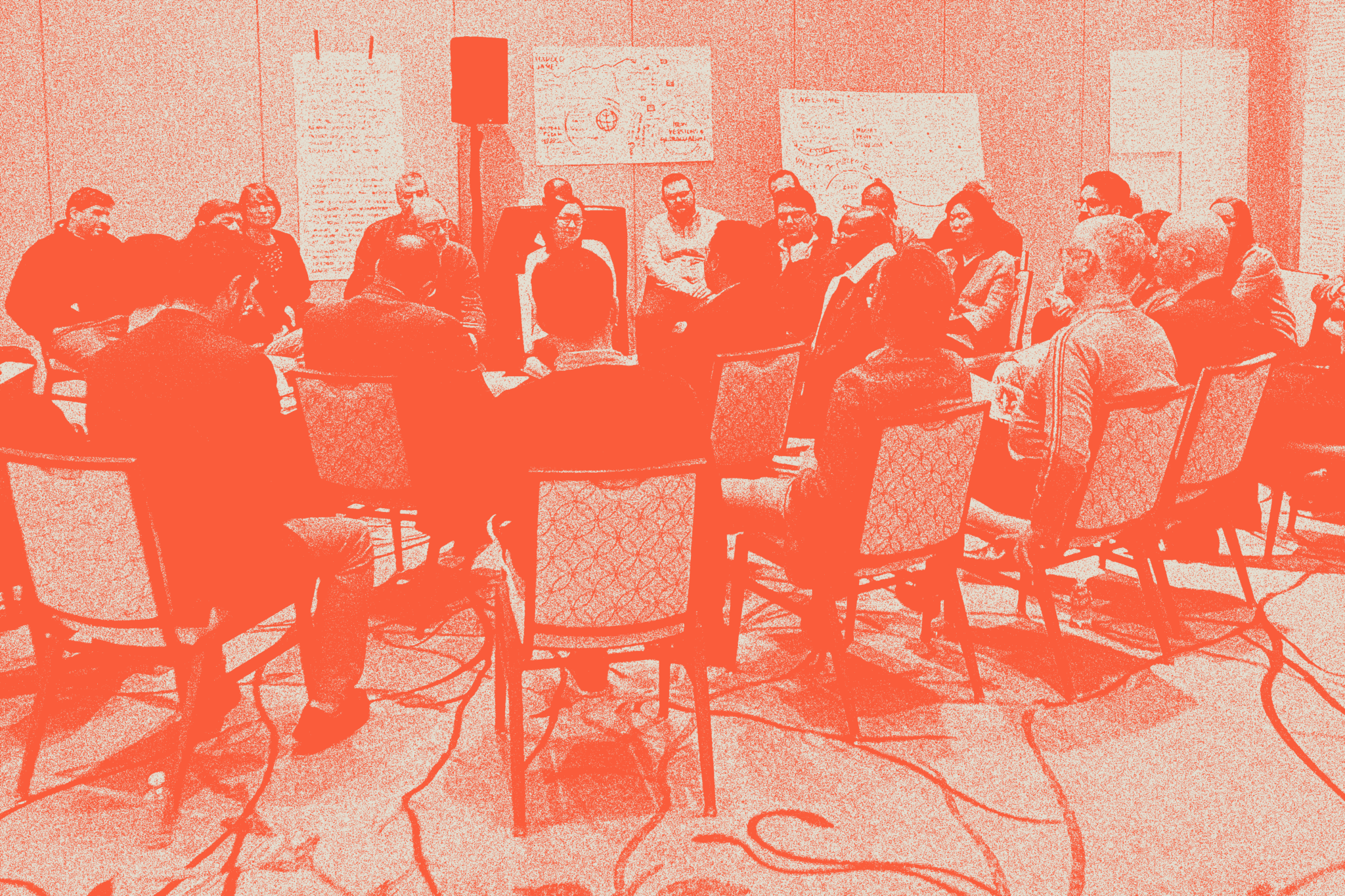
A few years ago, I worked with a board that had quietly stopped believing anything new could happen in its own room. Sixty people representing nearly two hundred countries gathered several times a week to do work that mattered to the global financial system and the geopolitical systems beyond it. Most of them understood, somewhere below the surface, that the form of their meetings had eaten the substance: there were monologues where there should have been dialogue; there was false unanimity where there should have been open inquiry; and the fragmentation was ritualized, frustratingly visible to the people inside it who could not find a way to change it.
A fragmented pattern can’t be directly confronted. It has to be coaxed from its protective crouch. To even begin to do this, you need to truly read what is in the room: what is in people’s minds and hearts, but more so the forces at work that are driving them to act as they do. Much of this remains unspoken, or as the inventor of the term organizational learning—my mentor and colleague Chris Argyris—once described it, “undiscussable.” Something that is hidden needs to come out.
I made clear to this room that there were more choices available than it seemed. My team and I talked to all sixty people, one by one. We promised confidentiality, invited genuineness, and overwhelmingly received it. We built enough mutual trust that when I put sixty flip charts on the wall and asked everyone to answer the same eight questions—things like, what’s your real vision for this institution, what are the hard truths we all need to face, what three changes would transform everything, and what do you need to do differently—they did it. And they walked around reading what everybody else had written, some of them for the first time genuinely encountering what their colleagues actually thought. This mutual witnessing awakened them.
“The room stays stuck because the people in it are stuck, not in the dynamics they can see, but in their distance from their own deeper intention.”
A real conversation had become so foreign that experiencing one felt like a revelation. It was a potential they had all openly wished for and privately stated deep skepticism about. “I am willing,” many had said to me. “But I doubt others are.”
Most of the time, we think of reading as looking for who is reacting to whom, or where the resistance lurks. You try to think about how to motivate, mitigate, or work around someone. Skillful reading of this kind can rearrange the visible dynamics of a room, sometimes usefully, but it usually does not open genuinely new possibility. Upstream of these patterns are the hidden assumptions people make about themselves and others. Even further upstream is the programming that keeps them from seeing their own fingerprints on the situation—how they have caused the very reactions they now observe. And behind all of this still is the not-yet-unfolded potential of the situation: what people long to have happen or sense is possible, but do not dare to state, or even let themselves recognize. When connection to this deeper signal is lost, no amount of downstream interpretation or manipulation restores it. The room stays stuck because the people in it are stuck—not in the dynamics they can see, but in their distance from their own deeper intention.
True reading, at its deepest, is listening past what is present toward what is trying to emerge, and toward whatever is holding it back. The conventional meaning of “reading a room” carries an extractive implication: scanning a situation to know what move will get you what you want. There is something detached and slightly predatory in that framing, the observer watching from outside. What I am describing here is its opposite. To genuinely read a room is to open yourself to it—to feel what is moving in the wider system, what is seeking to happen, and what is in the way. The first kind of reading can be done from outside. The second cannot. You can only hear what wants to come through if you are willing to be part of the field through which it might come.
Reading the room starts with inquiring into this larger context:
- What are they having to handle now?
- What are the pressures, opportunities, exigencies of the moment?
- What is the largest constraint? What are the patterns of persistent difficulty that they recognize are present?
- What substantive challenges and difficult choices are capturing them?
- What meaning do they make about the timing and rhythms of the moment they are in?
- Most fundamentally: What is possible now, that may not have been possible before? What is seeking to emerge?
This last question is fundamental. In every creative process, timing matters. There are things one must do differently at the beginning, the middle, and the end. Each phase opens some doors and closes others. A “phase” can be brief—a conversation—or extended, flowing over months or years. Different things matter at different phases. What happens at the outset of any cycle almost always determines everything that follows. My mantra: how things start is how things go. But equally, once things are in motion, despite intentions to the contrary, old habits, limiting mindsets, and limiting beliefs will always resurface. You have to address these and find a way through them.
Most leaders believe they already know how to read a room. They are observant people and they notice things. What they tend to miss is that much of what they notice—the energies they pick up, the opportunities that appear, the threats they begin calculating against—is a reflection of their own state, not the room’s. You enter, you perceive, you respond. The perception happens inside a set of reactions you did not choose and are probably not tracking. Three layers of these reactions keep most leaders locked onto what is already manifest, with no bandwidth left for anything else.
The parts that read for you
People typically begin any professional and many personal exchanges with protective energies: parts of them that want to keep themselves and their interests safe. They are right to be concerned; it’s a dangerous world, after all, and most people have been conditioned by trauma of one kind or another. In the board I was working with, the trauma was global, national, institutional, and sometimes personal, all at once. What’s missing in these settings is room to breathe and find a place to notice and temporarily set these reactions aside. Small moves on this front open large opportunities.
Think of these as parts of you, each with their own read on what’s needed and their own preferred response. Richard Schwartz has outlined this idea in his Internal Family Systems (IFS) model: the part that wants to solve; the part that wants to be seen as useful; the part that is already running a risk assessment on what this room might cost you. These aren’t character flaws. Rather, they’re the accumulated structures of experience and personality that have served you well enough to get you into the room in the first place. The trouble is they are not you, even when they feel like it. The leader who believes their instinct to act is identical with clear perception is confusing the instrument with the measurement.
There’s a structural version of this that goes deeper than individual habit. I owe this underlying framework to David Kantor, as expressed in his fittingly titled classic Reading the Room. Kantor identified three fundamental paradigms in which people operate:
- Open system people value inclusion, connection, teamwork and hearing everybody out.
- Closed system people value hierarchy, structure, and decisive execution, and value clarity and regularity about roles, accountability and decision rights.
- Random system people are improvisational and pattern-resistant, not wanting constraints, and doing what fits the moment; they do not want to impose or be imposed upon.
Each is a coherent way of being in a room, with its own strengths and its own blind spots.
Cross these three paradigms with three distinct languages—the language of affect and relationship, the language of meaning and ideas, and the language of power and action—and you have nine different ways a person might experience what’s happening and what should happen next. The open-affect leader in the room sees the closed-power leader as controlling or withholding, and insensitive to the inclusion of what’s most important: individual feeling. The closed-power leader wants to take action, and sees the other as naive and over-focused on feelings, not results. The random-meaning person wonders why everyone is so invested in having a consistent way to operate, rather than sensing what is present now without predetermined structure. All of them are reading aspects of the situation accurately from their angle. But none of them is seeing the whole room. They’re reading their own pattern projected onto the situation.
We are all capable of stepping beyond our preferred repertoire. The master practitioner can facilitate this movement, and speak to any of those nine patterns without being identified with any of them. The question the practitioner must always be asking: What pattern is in front of me, and what does it need right now? How do I join it accurately?
“You can only hear what wants to come through if you are willing to be part of the field through which it might come.”
The patterns you didn’t write
There’s a layer older than any of these: inherited patterns, absorbed so early, from people so close to us, that we experience them as simply the way things are. I’ve watched leaders walk into genuinely open situations carrying a fully formed story about how things are going to go wrong, which was a story they didn’t write and couldn’t easily name. The reactions feel immediate and personal, but they have a much longer history. This layer is at least as consequential as the more obvious ones, and considerably harder to see. A senior executive, walking into a board meeting where the room was actually waiting to listen to her, found herself bracing for an attack that wasn’t coming and preempting it with a defensiveness that produced exactly the dynamic she feared. The reaction felt immediate and personal; its origins were thirty years upstream of the meeting. These fossilized perceptions act and color the energy and feeling in the present, though their origins are in the past. They are the hardest layer to see, because they predate the part of you that for the moment dominates the seeing.
What these three layers have in common is that each one fills the available attention with reactions to what is already there. The parts react to the situation. The paradigms react to other paradigms. The inherited images react to a past projected onto the present. None of them can hear what is not yet there. The room’s actual potential—and what is preventing it from emerging—stay inaudible behind all the noise.
Meeting what is here
What actually helps is simple to describe and takes practice to do. First, you notice your initial reactions. You don’t suppress them, but you don’t let them direct the show either. You suspend them. Then you set them to the side—not permanently, just for now—and ask a different question: How do I feel now? What do I see now? How do I feel towards them? What’s actually present here, if I am no longer being directed by my reaction and stop trying to have something happen? This puts you in position to receive new information, and to see new potential.
Carl Jung was once asked about his method with patients. He said that in his later years he tried to arrive at each session having dropped all his theories and previous knowledge, and simply meet what was there. He sought to bring a beginner’s mind, an openness, which he felt was an aspect of a deeper dimension of himself. Jung’s quality of attention is available to anyone: we can come to meet what is now here with calm and curiosity. Not what should be here, not what you’re hoping is here. What is present now. The space beyond reaction is centeredness, and from inside it, a different order of perception becomes available.
When you actually manage to step back from the pull of your own reactions into something steadier, you become a centering point for the room rather than another irritating force in it. You can see your inclination toward a particular outcome without being run by it. You can feel the weight of the structural dynamics without being organized by them. You’re present to all of it, but you’re not overweighting any of it. That’s a different quality of attention than most rooms get from the person at the front of it.
Reading in the service of transformation
Here is the thing about reading a room: it is only interesting if it’s in the service of transforming it. Diagnosis without movement is just sophisticated observation. The point is to know what structural move the pattern in front of you actually needs.
In a room with a group that’s trying to move fast and yet feels stuck, the first thing I try to do is notice where the energy actually is, which is almost never where the agenda says it should be, and almost never where the loudest voices are directed. Often the most important thing in a room is what nobody is saying. The conversation is organized around one problem while the real constraint sits somewhere else, undiscussable because naming it would create discomfort someone in the room is working to avoid. You can only see that if your own agenda isn’t too loud.
In the board I described earlier, what I was reading was a faux-open space running on closed-power dynamics. Everyone espoused dialogue. The powerful delegations were quietly running the agenda and had been for years. The others knew it and said nothing. To move that room, I didn’t confront the pattern—that would have activated the very defenses I was trying to lower. I made structural moves to create enough safety that the real conversation could surface on its own. The field had to be set before new substance could emerge.
I work with executives who describe needing certainty and logical process regardless of what’s happening around them, as if the analytical framework were a permanent feature of who they are. In most cases it’s a part of them that developed because it worked, but now overplays its hand in situations where a different quality of attention is what’s needed. They are expected, they think, to bring answers, not questions. The framework becomes the place they retreat to when the room gets difficult, because looking directly at a difficult room requires putting down the tool that usually makes you feel secure and capable. That’s a habit, and habits can be interrupted, but you can’t interrupt them on someone else’s behalf—you can only create the conditions in which they can interrupt it for themselves.
That’s the art: you don’t transform the room, you get the room to transform itself.
Raising the room
Once you can hear what is upstream of the visible dynamics—what could be there, and what is in the way—your relationship to the room itself changes. You are no longer outside it, reading and adjusting. You are part of the field through which the not-yet-unfolded is trying to come, and the quality of attention you bring is part of whether it does. You are not a neutral observer. Your presence is part of what the room can produce. The room responds to what you are holding because what you are holding is upstream of what the room can become.
This is what it means to raise a room rather than merely read it: not to confront the pattern in front of you, not to rearrange the dynamics on the surface, but to restore—in yourself first, and then through your presence—the room’s connection to what it is actually capable of. The downstream rearranges itself once that connection is restored. In the board I described at the outset, the structural moves I made—the interviews, the flip charts, the eight questions—were not techniques for fixing the visible dynamics. They were ways of clearing enough space for the room to feel something it had lost contact with. Once it did, the fragmentation that had seemed permanent began, on its own, to give way.
The precondition for all of this is a quality of stillness that most leaders associate with passivity, but which in practice is the most active thing available: clearing enough of yourself out of the way that what is actually happening, and what is trying to happen, can register.
When you walk into your next high-stakes conversation, it’s worth sitting with a few questions at the outset:
- What are you inclined to have happen—and is that inclination yours, or something older?
- Which way are you wired: toward connection and inclusion, toward structure and decisive action, or toward improvisation and fit?
- Whatever your answer, do you know how that wiring will shape what you see and what you miss?
None of this requires long preparation. It requires a moment of honest attention. The leaders who develop this capacity do not bring fewer reactions into the room. What they bring is a steadier relationship to the ones they have—and through that steadiness, the room recovers its sense of what it can become.
The room will show you what it needs. You have to be able to hear it.
“You don’t transform the room, you get the room to transform itself.”